

Controlled and Balanced Drying Process in Belt Dryers
Belt Dryers
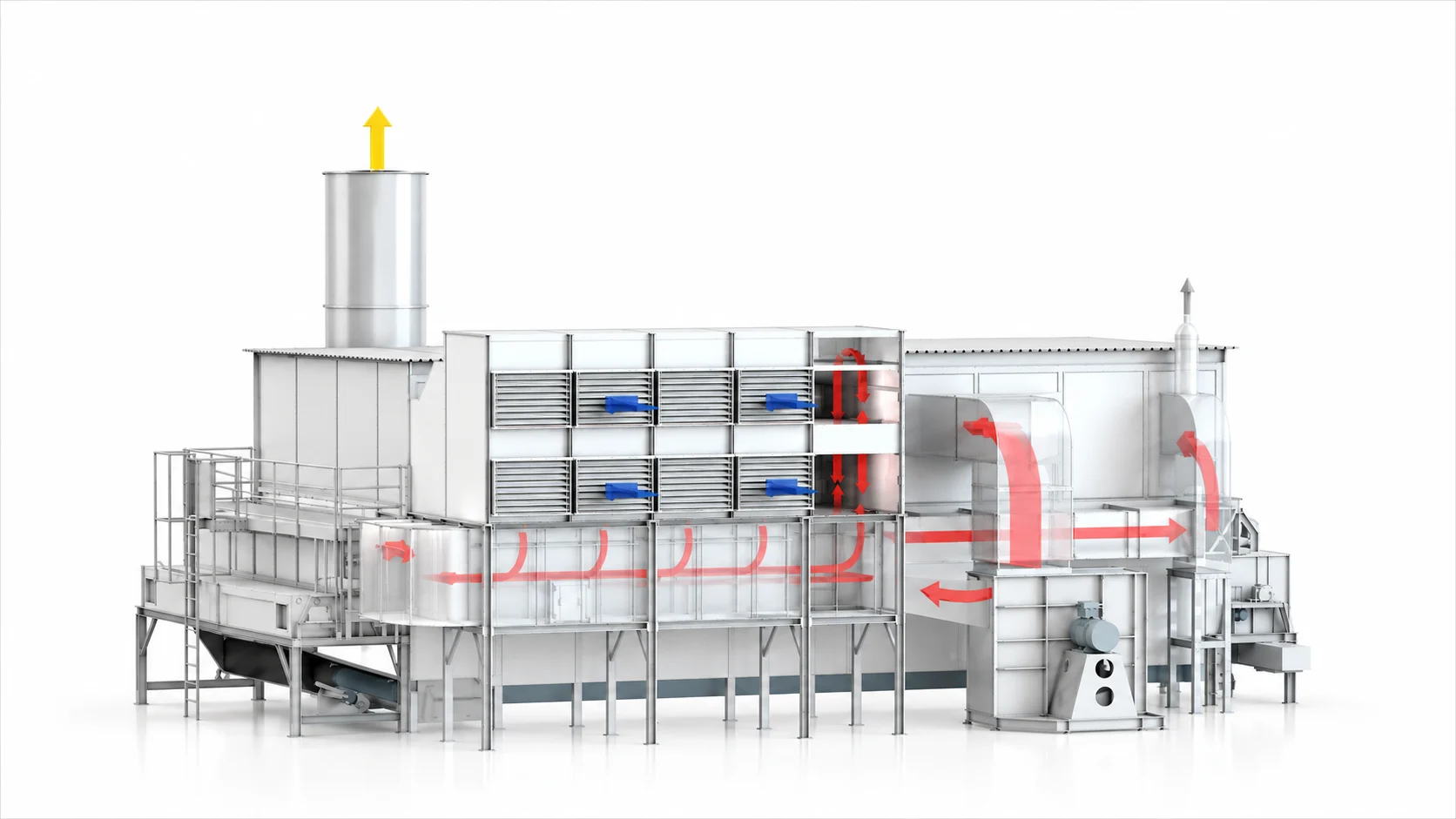
In belt dryers, the product moves in a controlled manner over a single-pass or multi-pass belt arrangement while coming into contact with the drying air. Drying performance depends on the proper management of parameters such as belt speed, product bed depth, airflow rate, temperature profile, and product distribution across the belt. A multi-pass dryer design provides longer product residence time within the same drying volume, enabling more controlled drying at lower temperatures. This configuration offers a major advantage, particularly in applications where preserving product structure is critical. ENIVO’s approach considers not only the dryer body itself, but also the feeding system, product spreading arrangement, air distribution, fan and filtration infrastructure, discharge conveyors, and automation system as part of an integrated whole. In this way, the process can be balanced to match the product’s characteristics with a high level of precision.
Operating Principle
Belt dryers are continuous drying systems developed especially for materials that are heat-sensitive, fragile, or require controlled product movement during the drying process. As the material progresses across the belt at a defined speed and comes into controlled contact with the drying air, the process achieves a balanced combination of product protection and drying efficiency. One of the key advantages of these systems is their multi-pass belt configuration, which allows operation at lower temperatures with longer residence times. ENIVO approaches belt dryers not simply as standalone drying equipment, but as process solutions engineered by evaluating product characteristics, target moisture content, temperature sensitivity, available installation space, and energy source together. This approach makes it possible to create a more controlled, more reliable, and more efficient drying infrastructure for each specific product.
Application Areas
Belt Dryers
Belt dryers can be used in a wide range of processes that require controlled, low-temperature drying, particularly for botanical products, food ingredients, minerals, fibrous materials, and products whose particle structure must be preserved.